In short
- Yes. The profile gets you seen on the map; the website gets you chosen. Google charges nothing for the profile.
- Get the address setting right. Shop, van or both each have a different rule, and working from home is allowed.
- Categories matter. Google says the ones you pick affect your local ranking.
- Check yours in fifteen minutes with the list at the end of this post.
Do you need a Google Business Profile if you have a website? Yes. Your website can look good and load fast while the phone still isn't ringing from people who've never heard of you. When a local business owner tells me that, the website often isn't the problem. The profile is.
Google Business Profile vs website: two jobs, and one is free
The profile gets you seen; the website gets you chosen. Only one of them costs money: Google says you can manage how your business shows up on Maps and Search at no charge.
What people see before they reach your website
Search "plumber Petersfield" on your phone. Before any ordinary website link, you get a map with a short list of businesses, and tapping one opens photos, reviews, opening hours and a call button. All of that comes from the profile.
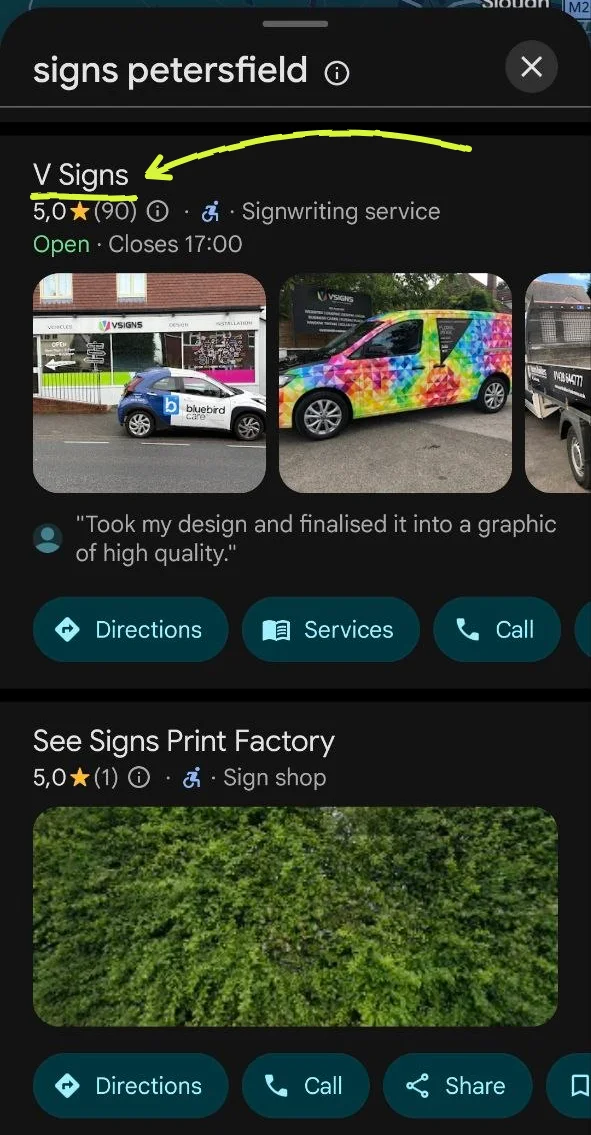
Google says local results are mainly based on relevance, distance and popularity, and that businesses with complete and accurate information are more likely to show up. A half-filled profile gives Google very little to go on.
What a website does that the profile can't (and the other way round)
The profile is brilliant at the first ten seconds: where you are, whether you're open, what others thought, one tap to call. But it's Google's layout and Google's fields. It can't explain what a job involves, give each service and town its own page, or take a detailed enquiry.
That's the website's job. And the two feed each other. Google builds your profile partly from your own website, and if someone suggests an edit to your profile, Google may publish it after four days if it's supported by public information such as your website. A website that agrees with your profile protects it.
Shop, van or both? Getting the address setting right
Google treats three kinds of business differently (guidelines, service areas):
- A shopfront. Customers come to you. Show your address.
- A service-area business. You go to customers and don't serve them at your address. Hide the address and set a service area instead. This is the right setting if you work from home.
- A hybrid. Customers can visit you, and you also go out to them. Show the address and set service areas too.
You can set up to 20 service areas, by town, postcode or region. One rule to know: a virtual office doesn't count unless it's staffed during your opening hours.
What I changed on V Signs' profile
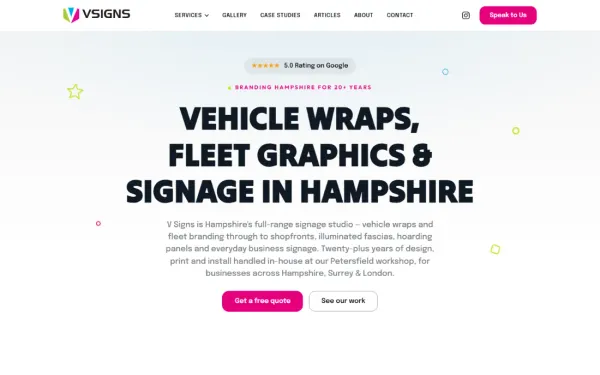
V Signs are a sign and wrap company near Petersfield, with a workshop in Rake. Their profile shows the workshop address and also sets the towns they cover. When I started, their profile had one category, no business description, a longer version of their name, and an address that still carried the name of a business that left the unit more than ten years ago. The cover photo was another company's van.
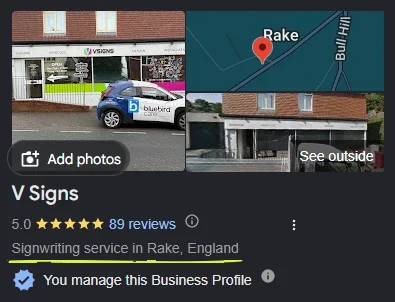
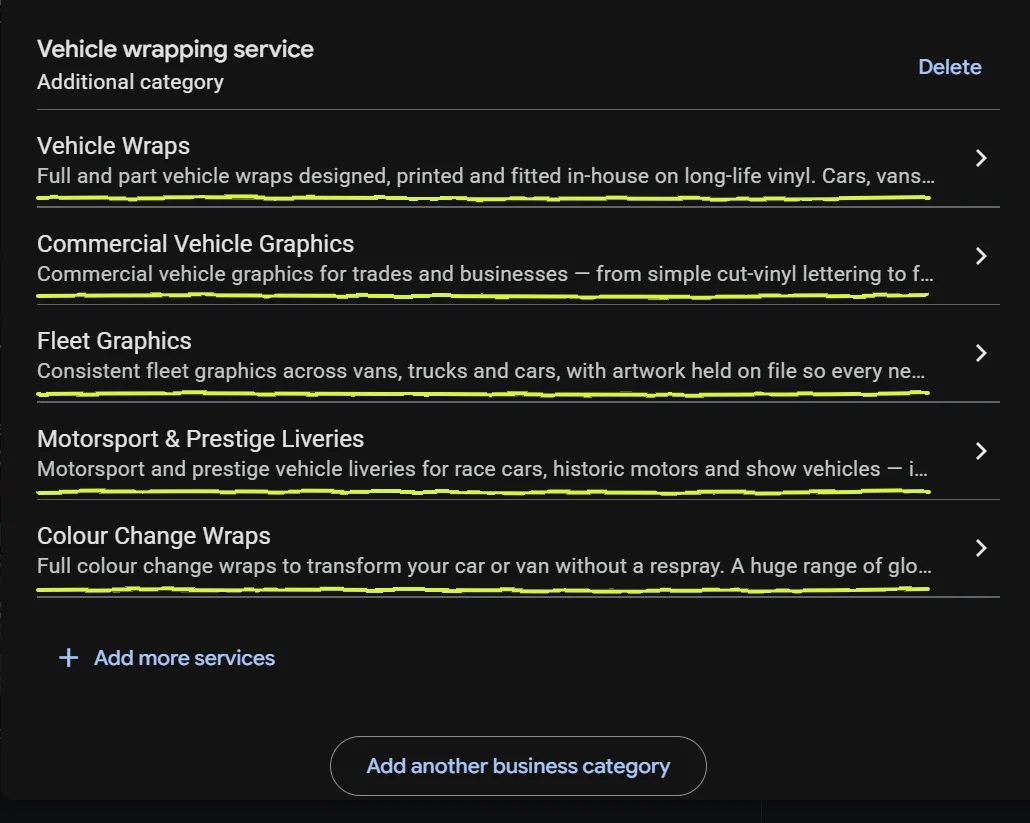
Here's what I changed, and why:
- Name to plain "V Signs", the name on their sign and their website. Google's rule is to use your real-world name. I made that edit on its own, before anything else, to keep the risk of re-verification low.
- Address corrected to the Royal Mail version: added the missing Liss post town, removed the old business name, and dropped "Hampshire" (Rake is officially West Sussex). Hampshire stays in the service areas and the copy.
- Categories from one to five: Signwriting service as the primary, plus Sign shop, Vehicle wrap shop, Graphic designer and Print shop. Google says the categories you choose affect your local ranking, and to use as few as describe the business. Each of those five is real work they do.
- Service areas set to the towns they want, and deliberately not Portsmouth, which is outside their market.
- The rest: a proper description, a full services list, replies to unanswered reviews, their own work as the cover photo, and a weekly post.
What happened? It's too early to say. Their new site went live on 5 September 2026. Before I touched anything, I saved six months of their profile data as a baseline, and it showed that nearly everyone who found them was already typing their name. All of this work is aimed at the people who don't know them yet. I'll write up what changed once there's enough data to be fair.
Fifteen minutes to check yours
Open Google Maps on your phone, search your business name, and check:

- The name matches your sign and your website, with nothing added.
- The address, or service area, is right for how you actually work.
- The phone number rings you.
- The primary category is the most specific one that fits.
- The description says what you do and where.
- Your opening hours are current.
- The photos are yours, and recent.
- Every review has a reply.
- The website link goes to your real homepage.
If more than a couple are wrong, it's worth an afternoon. What local SEO means for a trade business covers the next step.
If you'd rather I did it, this is what my Local SEO setup is for: £350 one-off to set your profile and listings up right. Every website pack I build, from The Pup at £500, includes a profile tidy-up (my prices). Tell me about your business and I'll take a look.
Questions people ask
Is a Google Business Profile free?
Yes. Google's own help page says you can manage how your business shows up on Maps and Search at no charge. You pay for help setting it up well, not for the profile itself.
Can I have one if I work from home?
Yes. Set it up as a service-area business and clear your home address, so the profile shows the area you cover instead. Google gives a plumber working from home as its own example of doing exactly this.
Does a Google Business Profile replace my website?
No. The profile is a fixed set of fields in Google's layout: a map pin, a phone button, photos and reviews. The website is where you explain the job, show the proof and take a proper enquiry, and Google reads it to check your profile is telling the truth.

Born in Petersfield in 1986, now based in Poland. Twenty-five years running real businesses, and now I build websites, local SEO and socials for Hampshire small businesses. Every price I quote is on one page.
Want a straight answer for your business?
Tell me what you do and where. I'll come back within one working day with a fixed price, not a range.